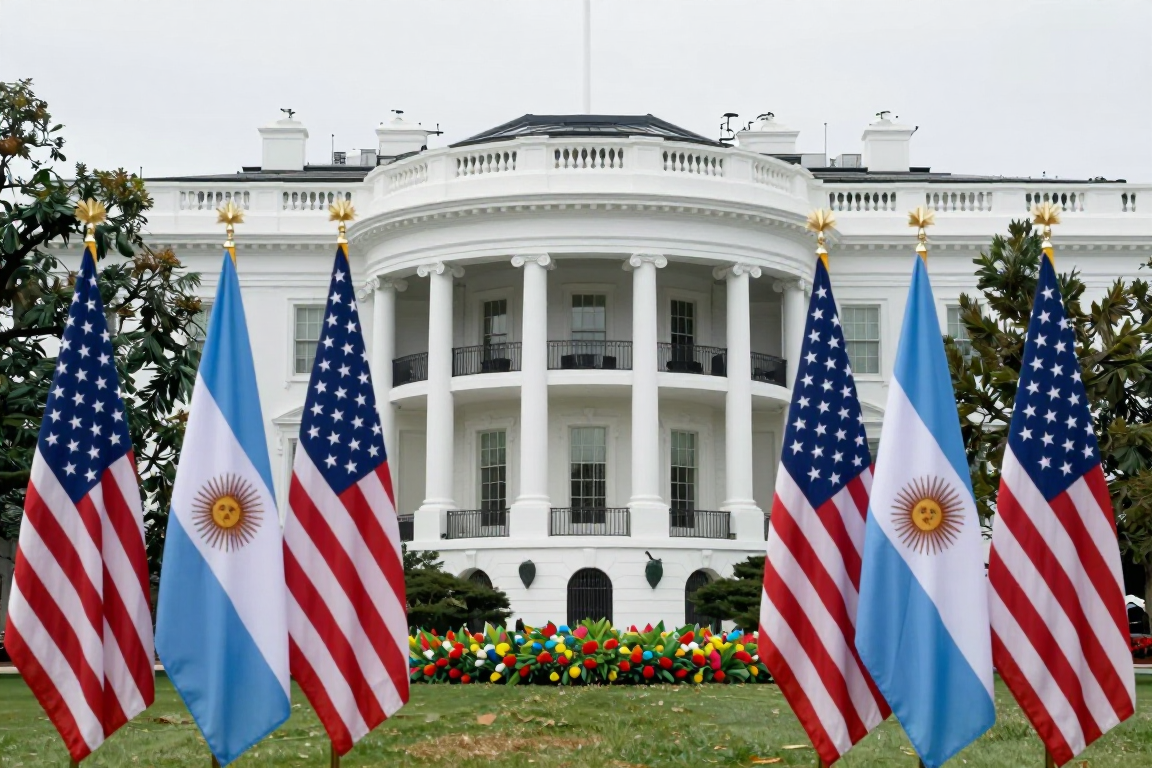
WASHINGTON, May 2, 2025 (Reuters) — The Biden administration indefinitely postponed planned Trade and Investment Framework Agreement (TIFA) negotiations with Argentina on Wednesday, a week after President Javier Milei publicly endorsed Donald Trump's 2024 presidential campaign at a Conservative Political Action Conference event in Maryland — a diplomatic freeze that highlights the risks of Milei's ideological approach to foreign policy.
The State Department confirmed the postponement in a brief statement, citing "scheduling conflicts" but offering no alternative date and declining to answer questions about when talks might resume. Two administration officials, speaking on condition of anonymity because they were not authorized to discuss internal deliberations, said the decision was directly tied to Milei's CPAC appearance, where he called Trump "the leader the free world needs" and criticized the Biden administration's climate and economic policies as "collectivist delusions."
"You don't get to campaign against the sitting president and expect his administration to roll out the red carpet for trade talks," one official said. "Milei made his choice. Now he lives with the consequences. Argentina is not the only country with lithium."
The TIFA negotiations, which began in January after months of preliminary discussions, had been expected to produce a framework agreement by June that could eventually lead to reduced U.S. tariffs on Argentine beef and biodiesel exports. Those products currently face bans or prohibitive tariffs that predate the Biden administration but that U.S. agricultural lobbyists have fiercely defended, arguing that Argentine exports threaten domestic ranchers and soybean farmers.
Argentina's ambassador to Washington, Gerardo Werthein, said he was "disappointed but not surprised" by the postponement. "President Milei speaks his mind. That is his style. But Argentina's interests transcend any single administration in Washington," Werthein told reporters at the Argentine embassy on New Hampshire Avenue. "We will continue working with both parties."
The diplomatic freeze highlights the complexity of Milei's U.S. strategy, which has prioritized relationships with the Republican right over traditional bipartisan engagement. Since taking office, Milei has met with Trump three times, appeared on Tucker Carlson's podcast twice, and drawn praise from Senators Marco Rubio and J.D. Vance.
Republican lawmakers responded to the TIFA freeze by introducing legislation that would fast-track trade preferences for Argentina outside the Biden administration's framework. Senator Rubio said he would attach the provision to the upcoming defense authorization bill.
"The Biden team is punishing Argentina because Milei likes Trump. That's petty diplomacy," Rubio said on the Senate floor. "Argentina is a key ally in South America at a time when China is buying influence across the region. We should be strengthening ties, not freezing them over campaign rhetoric."
Bilateral trade remains modest at approximately $14 billion annually, heavily weighted toward Argentine agricultural exports and U.S. machinery and technology imports. The TIFA freeze is unlikely to halt commercial ties but removes a mechanism for expanding them.
Wilson Center Latin America program director Cynthia Arnson said the TIFA freeze is a diplomatic slap, not an economic earthquake. But it shows the limits of Milei's ideological diplomacy. You can't be a partisan player in U.S. politics and expect the other party to treat you as a neutral partner.